Warehouse Floor Storage Is a Signal of Misalignment
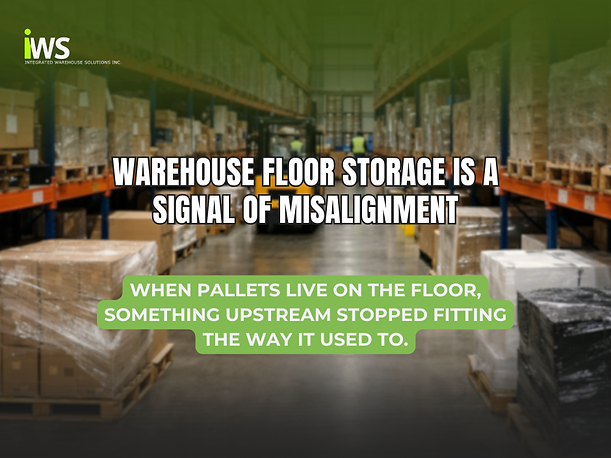
Warehouse floor storage doesn’t usually start as a strategy. It starts as a response.
A pallet comes in and there’s no clean place to put it. Access is tight. Racking is full in the wrong places. So the floor gets used.
At first, it feels reasonable. Work keeps moving. Shipping stays on pace. The problem is what happens next.
Why Warehouse Floor Storage Shows Up Over Time
In most warehouses, floor storage isn’t caused by one bad decision. It’s the result of several good decisions that never got revisited.
Racking was installed for a specific product mix. Equipment was chosen for a certain aisle width. Slotting made sense at a lower volume. Then the operation changed.
Volumes increased. Product profiles shifted. Turnover changed. The physical layout stayed the same. Eventually, the floor absorbs the mismatch.
Why Floor Storage Becomes Normal
Once warehouse floor storage is part of daily work, it stops feeling temporary.
People use it because:
It avoids fighting access issues
It keeps pick paths moving
It’s faster than reworking layout under pressure
At that point, floor storage isn’t a shortcut. It’s part of the system. The risk is that it hides the real constraint. Extra handling increases. Travel paths shrink. Access becomes harder.
But nothing “breaks,” so it stays.
What Warehouse Floor Storage Is Actually Telling You
When pallets live on the floor, the warehouse is giving feedback.
Usually, it points to misalignment between:
Racking and current inventory flow
Equipment and aisle design
Vertical capacity and how it’s being used
This is where racking decisions matter, and when it becomes time to look into pallet racking solutions.
Not as products, but as infrastructure.
Why Expansion Isn’t the First Answer
Warehouse floor storage often leads to the same conclusion: “We need more space.”
Sometimes that’s true. Often, it isn’t the first thing to fix.
We regularly walk buildings where:
The footprint hasn’t changed
The racking hasn’t changed
The operation has
Before adding square footage, it’s worth checking whether existing systems still support clean movement and access.
This is also where safety and compliance come into play, and you can check out our pallet racking inspection services.
More pallets on the floor usually means more handling, more congestion, and more risk, even if nothing feels unsafe yet.
What to Look At Before Accepting Floor Storage
If warehouse floor storage has become routine, start here:
Are pallets on the floor because access to racking is limited?
Does equipment still fit the layout it’s operating in?
Is vertical space available but unused?
Are fast-moving items stored where they should be?
Often, small corrections remove the need for floor storage entirely. Not through overhauls, but through alignment.
Conclusion
Warehouse floor storage isn’t only the problem. It’s a signal.
It shows where layout, racking, and equipment stopped matching the way work actually happens.
Before assuming expansion, more labour, or tighter rules are needed, it’s worth looking at what changed, and what didn’t.
That’s usually where the answer is.
Learn more about how we approach layout, racking, and flow here: Integrated Warehouse Solutions.
Current Kijiji Listings (Updated Weekly)
Below are current inventory listings related to racking and layout solutions. Availability rotates weekly based on region and demand.
If a listing has expired or you are looking for something specific, contact us and we will confirm current availability and options.


Comments