Drive-In Racking: Theoretically the Densest
Updated: Aug 1
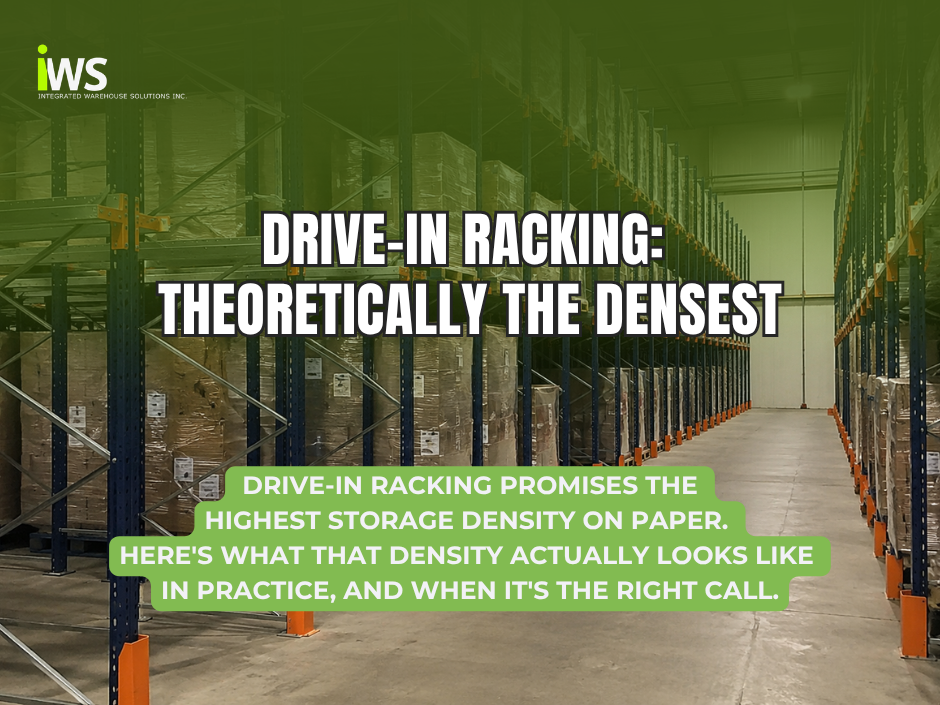
Drive-in racking eliminates the aisles that selective racking needs between every row. Instead of moving a forklift down multiple corridors, you drive straight into the rack itself and load pallets deep into lanes. The result is significantly more storage in the same footprint compared to selective systems.
The system is built for high-volume, homogeneous inventory. You load pallets into a lane, they stack deep, and you pull from the same end they went in. Last in, first out. It's simple, it's compact, and on paper it's incredibly efficient.
Drive-in racking works best when you've got large quantities of the same SKU, the kind of operation where you're moving pallets of identical product in predictable volumes. Food distribution, beverage storage, bulk goods. If your inventory profile matches that, drive-in can be a solid choice.
Where Drive-In Racking Gets Complicated
Here's where the reality gets interesting. Drive-in relies on LIFO sequencing and tight lane discipline. When that works, density is high. When it doesn't, when product mix varies, SKU velocity changes, or lanes don't fill perfectly, something called honeycombing starts eating into your actual capacity.
Honeycombing happens when lanes sit partially empty because you can't access blocked positions without pulling pallets out of order. A lane that should hold ten pallets might only have six usable ones because the other four are buried behind product that doesn't need to move yet. The positions exist, but you can't get to them without disrupting the whole lane.
Real-world utilisation on drive-in systems typically runs around 80 to 85 percent. That gap between theoretical capacity and what you actually use matters, especially when the decision to go with drive-in was based on the theoretical number.
The Lot Control Problem
Honeycombing gets worse when lot control is in play. Say you run a five-deep drive-in system and you produce inventory in lots of five. When everything works perfectly, each lane fills completely and the system performs as designed.
But the moment you sell one unit from a lane, you're down to four. That slot can't be refilled until the next full lot is ready. And if your operation requires lot separation, meaning you can't mix an old lot and a new lot in the same lane, you now need an entirely separate location just to avoid burying old stock behind new.
One operational requirement, and suddenly you need twice the lanes to manage the same volume.
This is the gap between how drive-in performs in a brochure and how it performs on a real floor. The theoretical density assumes perfect conditions: identical product, consistent volumes, complete lane fills, no lot separation requirements. Real operations rarely deliver all four at once.
What the Utilisation Gap Actually Costs
An 80 to 85 percent utilisation rate sounds acceptable until you run the numbers against what you paid for.
If you installed drive-in racking expecting 500 pallet positions and you're consistently accessing 400 to 425 of them, you've paid for 75 to 100 positions that aren't usable under normal operating conditions. At typical pallet storage rates, that's real money sitting in the rack doing nothing, every month, for the life of the system.
The alternative isn't always more racking. Sometimes it's a different system that delivers similar pallet counts with fewer operational constraints. That's the comparison worth making before the steel goes in.
Building Constraints Matter Too
Drive-in systems aren't just an inventory decision. They're a building decision.
Column spacing in your facility affects how deep your lanes can run and where they can sit. A building column in the wrong position relative to a drive-in lane can force you to shorten the run, which directly reduces the density advantage you were counting on.
Lane depth also triggers fire code requirements once you get beyond a certain point, potentially requiring in-rack sprinklers or specific flue spacing that adds cost and structural complexity.
None of this means drive-in is the wrong choice. It means the right answer requires looking at your building, your inventory, and your operational patterns together, not just comparing price-per-pallet-position on a quote sheet.
When Drive-In Racking Makes Sense
Drive-in earns its place in specific operations. High volume, single SKU, predictable movement patterns where LIFO sequencing isn't a problem. If you're loading full lanes of identical product and pulling them out in the same order, the system performs close to its theoretical max.
The moment your operation introduces variability, mixed SKUs, or irregular movement patterns, that utilisation number starts dropping. And once it drops below what a well-designed selective system would deliver, the density advantage disappears.
Knowing which side of that line your operation sits on is the question worth answering before the racking goes in, not after.
Next in the series: push-back racking. Coming soon.
Learn more about warehouse operational planning and workflow optimisation:
Warehouse layout planning and storage systems: https://www.iwarehousesolutions.com/services/storage-systems
Operational workflow and cost reduction planning: https://www.iwarehousesolutions.com/services/operational-cost-reduction-planning
Contact IWS:


Comments